

Don’t miss out on the fire-resistant and disaster-reducing benefits of aluminum-clad wood windows!
Release date:
2025-09-01
Before reading this article, let’s first clarify that fire resistance and fireproofing are entirely different concepts. According to sources from the American Institute of Timber Construction, there is no such thing as a truly fireproof building. In fact, most materials used in buildings are combustible—and often it’s the burning of items inside the structure, rather than the structural components themselves, that poses the most serious threat to lives and property. As a result, the safety design focus for building materials has increasingly shifted from "fireproofing" to "fire resistance." Now, let’s take a closer look at how various door and window profiles perform under fire conditions.
The average temperature during a typical building fire ranges between 700 and 900°C. Below is how wood, steel, aluminum alloy, and PVC behave in the event of a fire:
1. Strength:
When the temperature rises to 230°C, the strength of steel drops sharply—by 750°C, it retains only 10% of its original strength—and often collapses suddenly, almost without any warning.
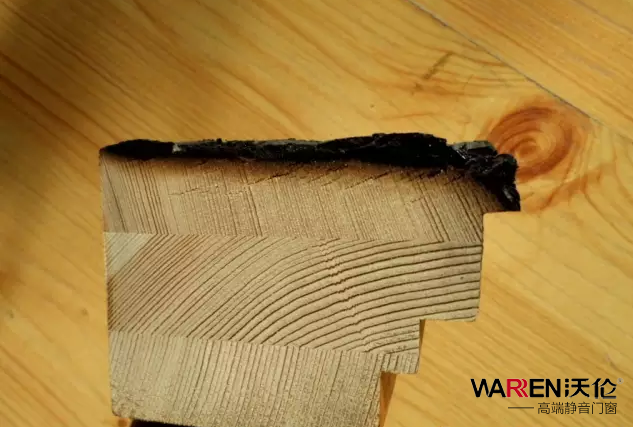
Wood, on the other hand, only begins to burn when the temperature reaches 250°C. In intense fire conditions, wood typically chars at a rate of 0.64 millimeters per minute. The resulting char layer naturally insulates the wood from external heat and significantly boosts the temperature resistance of the timber component. For instance, if an aluminum-clad wood window system like the 68 model is exposed to an open flame at 800°C for 30 minutes, only 19 mm of the material will char—representing 27.9% of the total thickness—while the remaining cross-section remains completely intact.
2. Flash Point and Melting Point:
A lit cigarette butt can reach a core temperature of 700–800°C, while the temperature of open flames during a fire typically exceeds this range. Aluminum alloy has a melting point of 650°C, and even if fire-resistant glass is used, the window frame may collapse before the glass falls, rendering it ineffective.  The melting point of PVC is between 120°C and 210°C, and plastic steel windows cannot be converted into fire-rated windows. While steel windows can be fitted with fire-resistant glass to become fireproof, they are rarely used today due to their poor thermal insulation properties. On the other hand, wood has a combustion point of 250°C. In the event of a fire, the outer layer of wood will ignite first; however, thanks to wood's excellent heat-insulating ability and the protective carbonized layer that forms as it burns, heat is effectively blocked from spreading to the unburned side, preventing surrounding materials from catching fire.

3. Combustion Experiment
"But isn’t wood a combustible material? How can it possibly offer the best fire resistance?" Some people may still hold this common misconception. Let’s take a look together at a combustion test that was once conducted in Germany—afterward, you’ll likely gain a whole new perspective on wood and wooden doors and windows.

They subjected PVC windows and doors, solid wood windows and doors, and aluminum alloy windows and doors to high-temperature combustion using a high-pressure flame gun for over 30 minutes each, resulting in the shapes shown in the image above.
We all know that PVC is a combustible material that releases toxic gases when it burns, making its damage the most severe. Next in terms of preservation are aluminum alloy doors and windows—aluminum alloys are widely recognized for their exceptional strength. However, their melting point ranges between 580 and 650 degrees Celsius. Once this temperature is reached, the aluminum alloy begins to melt, as seen in the image where the frame of the aluminum window has already started to soften and deform.
Among these materials, wooden doors and windows remain the best-preserved. While wood is inherently flammable, it chars during combustion, creating a protective carbon layer that effectively slows down further burning. Additionally, the wood used in aluminum-clad wooden windows is specifically processed into engineered timber, which has undergone rigorous fire-retardant treatments during manufacturing. This makes aluminum-clad wooden windows not only highly resistant to fire but also capable of maintaining their structural integrity even in a blaze, providing critical time for safe evacuation and minimizing disaster risks.
Latest News


Contact Information
Contact Address: No. 7, Industrial Avenue East, Songxia Industrial Park, Shishan Town, Nanhai District, Foshan City
Warren Doors and Windows, south of Fangshan Road and west of Dongtai Road, Dongcheng Subdistrict, Linqu County, Weifang City, Shandong Province
Become A Deaters :Info@wolunmc.com
National customer service hotline:+86 400-676-9888
WhatsApp:+86-18866798677
Beijing customer service phone number:+86 010-68319888


Douyin

Xiaohongshu
E-mail:
Tel:
400:
The Little Red Book:
Tiktok:
WeChat:
在线客服添加返回顶部
页面顺滑的滚动
右侧在线客服样式 1,2,3 4
图片alt标题设置: Beijing Warren Doors and Windows Co., Ltd.
循环体没有内容时: Materials are currently being organized—stay tuned!
CSS / JS 文件放置地